CPC-Playground, un IDE z80 en ligne par Gurneyh for Amstrad CPC programming
-CPC-Playground by Gurneyh is an online IDE for Z80 programmation for Amstrad CPC. The code of CPC-Playground is available on Github.
CPC-Playground by Gurneyh is an online IDE for Z80 programmation for Amstrad CPC. The code of CPC-Playground is available on Github.
First released in 2024, IDE 8BP by Toni Hernandez let you program for Amstrad CPC and the 8BP library on Windows (8BP on Github). The last version of this IDE was released today.
You can order the issue 4 in english of the newspaper 64 NOPS on Ulule. It's a project by Hicks/Vanity and Toms/Pulpo Corrosivo, the cover is made by Beb, 64 pages A4 and delivery will be in February 2026.
Don't forget the 64 NOPS web site even if they are no new articles since a moment.
The last version of the multi platform assembler for Amstrad CPC RASM (v3.0.3) by Roudoudou is available since yesterday on Github.
This multi platform assembler for Amstrad CPC (for linux, windows, and also MorphOS on Amiga) let you program for Amstrad CPC. It's recommended to use it with the new emulator also by Roudoudou : ACE-DL.
Amstrad Power presents Universal Basic Library (UBL) by Orac81 which is a basic library for Amstrad CPC but also for C64, VIC-20, C16, PET, DOS QBasic, Apple II, Dragon 32, BBC Micro, ZX-Spectrum, MSX, TRS-80, Exidy Sorcerer and Ohio Superboard. UBL will use the lines 1 to 49 (fast function) and 9500-9999 (heavy functions), you code will then use lines 50 to 9499.
You can download a .DSK compiled by shacpc with examples programs using UBL.
Ayane by Madram is an Amstrad CPC utility to read musical files. It's not a final version, but a WIP version to let you know the features of Ayane that you can donwload on Pouet, and also listen to with a Youtube video of Ayane.
The last version of the multi platform assembler for Amstrad CPC RASM (v3.0) by Roudoudou is available since yesterday on Github.
This multi platform assembler for Amstrad CPC (for linux, windows, and also MorphOS on Amiga) let you program for Amstrad CPC. It's recommended to use it with the new emulator also by Roudoudou : ACE-DL.
This new version features :
Z88dk is a development toolkit whose target are notably the Z80 (but not only) which permits to program in C and/or assembler for Amstrad CPC, Notepad NC100/150/200 and PCW (and many more computers) on PC and MacOS.
The last version of Z88dk was released the 2th October 2025 on Github.
The last version of 8BP (v043, a programmation framework) is presented by his author on his web site. This version is available since yesterday.
The documentation of 8BP is now available in five languages.
And if you want to program with 8BP under windows, then why not take a look at IDE8BP written by Toni Longo and released at the end of May 2024. You will find a présentation of IDE8BP's features on AUA.
Adventure by Will Crowther and Don Wood is a an adventure game created in the 1970s and sometimes considered like the first adventure game et parfois considéré comme le tout premier. Adventure a été réécrit par Fredrik Ramsberg et son logiciel de création PunyInform (local download of Adventure). It is available for more than 25 platforms including the Amstrad CPC and PCW.
PunyInform v6.0 by Fredrik Ramsberg and Johan Berntsson is a library written in Inform 6 to create adventure game (pure text, no graphic support contrary to DAAD) using the Z-machine virtual machine which will run on 8bit computers (or more recent computers too). PunyInform has a parser, knowing of common verbs and a framework to write adventure games.
PunyInform is based on the Inform 6 library written by Graham Nelson. Its goal is to make easily adventure games in Inform 6, with a manual describing the differences between the official library and PunyInform.
Games using PunyInform can be compiled in z3, z5 and z8 format (z3 being the best format for 8bit computers, other formats have more features). Compared to the Inform 6 library, it means that there is no support for the Glulx virtual machine but z3 format is important as Inform 6 doesnt support it.
To compile games written with PunyInform, you should use the Inform 6 compiler maintained by David Kinder. Binaries are available on if-archive. PunyInform v6.x needs Inform v6.43(or more).
They are tutorials to write adventure game with PunyInform (end of the page) and all the documentation including a 8 page cheat sheet (quick reference)..
To try your game after compilation, you can use WinFrotz by David Kinder, to create map easily you can use Trizbort.
And finally, to create an Amstrad CPC and PCW disk image, you will have to use the Puddle BuildTools which works under linux, windows 1x with WSL2 or MacOS with Intel processor and OrbStack.
The last version of multi platform assembler for Amstrad CPC RASM (v2.3.8) was released two weeks ago on Github.
This multi platform assembler for Amstrad CPC (for linux, windows, and also for MorphOS on Amiga) let you program for Amstrad CPC. It's recommended to use it with the new emulator also by Roudoudou : ACE-DL released today, to get symbols and breakpoints importation and much more.
CPC Analyzer (for windows, can be compiled on MacOS and Linux) by Crabfists is an utility to reverse engineering Amstrad CPC programs : it's a combination of an emulator, debugger & interactive disassembler. Programs are loaded and run in the emulator and their state can be inspected using the tools provided. It's a port of Spectrum Analyzer by Mark Craig. The current features of CPC Analyzer are :
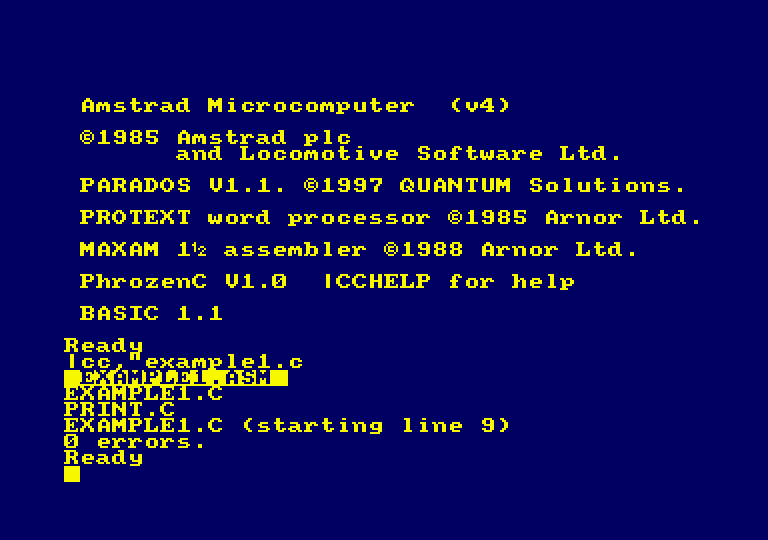
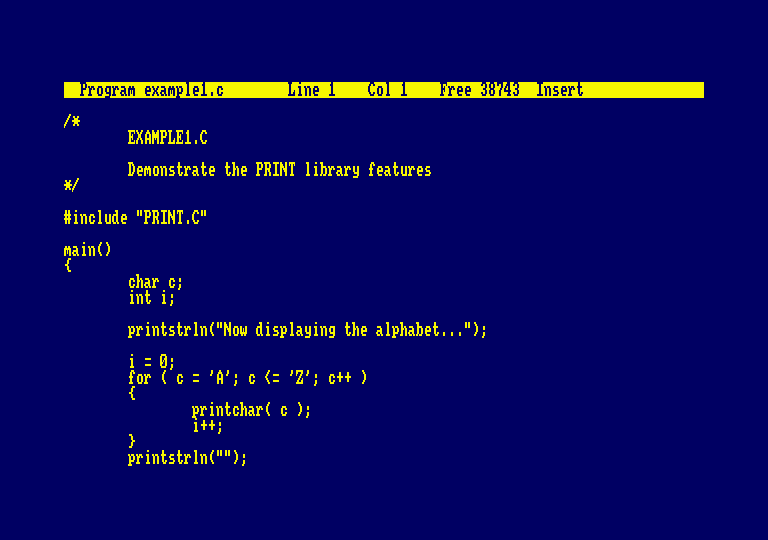
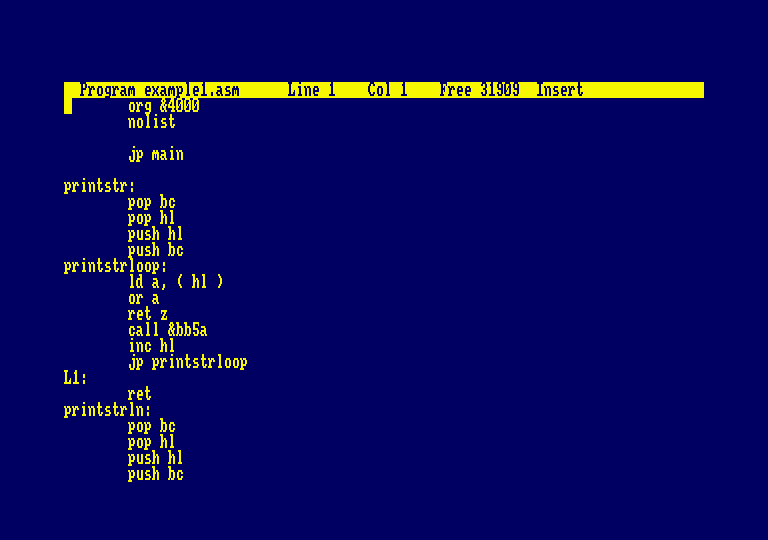
PhrozenC v1.0 is a K&R C compiler (Dennis Ritchie and Brian Kernighan, it's not ANSI C) for Amstrad CPC and PC by NoRecess. On PC it compiles a .C file in .ASM ready to compile with WinAPE. On CPC the .ASM file can be compiled with Maxam.
The source code of PhrozenC is available on Bitbucket.
For Amstrad CPC it exists a ROM version (prefer this version), a 64 Kb version (stand-alone application) and 128 Ko version (RSX).
PhrozenC is released with a PDF manual covering all the things you have to know about to start programming using PhrozenC.
There is even a small tutorial about learning C for the newcomers. Example sources are available, as also a small set of library files handling file management, graphics, memory management, string concatenation, etc...
Turbo Rascal SE (TRSE) v0.19 (spring 2025) is out. It's a complete suite (IDE, compiler, programming language, image sprite level resource editor) intended for developing games/demos for 8 / 16-bit line of computers, with a focus on the MOS 6502, the Motorola 68000, the (GB)Z80 and the 8086. TRSE supports application development for the C64, C128, VIC-20, PLUS4, NES, Gameboy, PET, ZX Spectrum, TIKI 100, Amstrad CPC, Atari 2600, 8086AT, Amiga 500 and the Atari ST 520 (complete list here). With the benefits of a modern IDE (error messages, code completion, syntax highlighting etc) and a bunch of fast built-in tools, it has never been easier to program for your favorite obsolete system !
You can join the TRSE group on Facebook.
The video below is a gorgeous Amstrad CPC demo programmed with TRSE : Morketid, a very good one in my personal opionon.
For more news, Go to home page